



Umut Burgaz

Postdoctoral Research Fellow, Trinity College Dublin

I am an observational astronomer studying Type Ia supernovae and their use in precision cosmology. My work combines spectra, light curves and host-galaxy measurements to understand the physical diversity of these explosions, trace how their environments shape observed properties, and reduce systematic uncertainties in distance measurements. I work with major time-domain surveys including ZTF, Rubin/LSST, TiDES-4MOST and LS4.

Research

1. Spectral Diversity and Classification How do Si II line strengths and observational contamination reveal the physical diversity of Type Ia supernovae? I use a volume-limited ZTF sample to connect classification with ejecta conditions.

Key findings

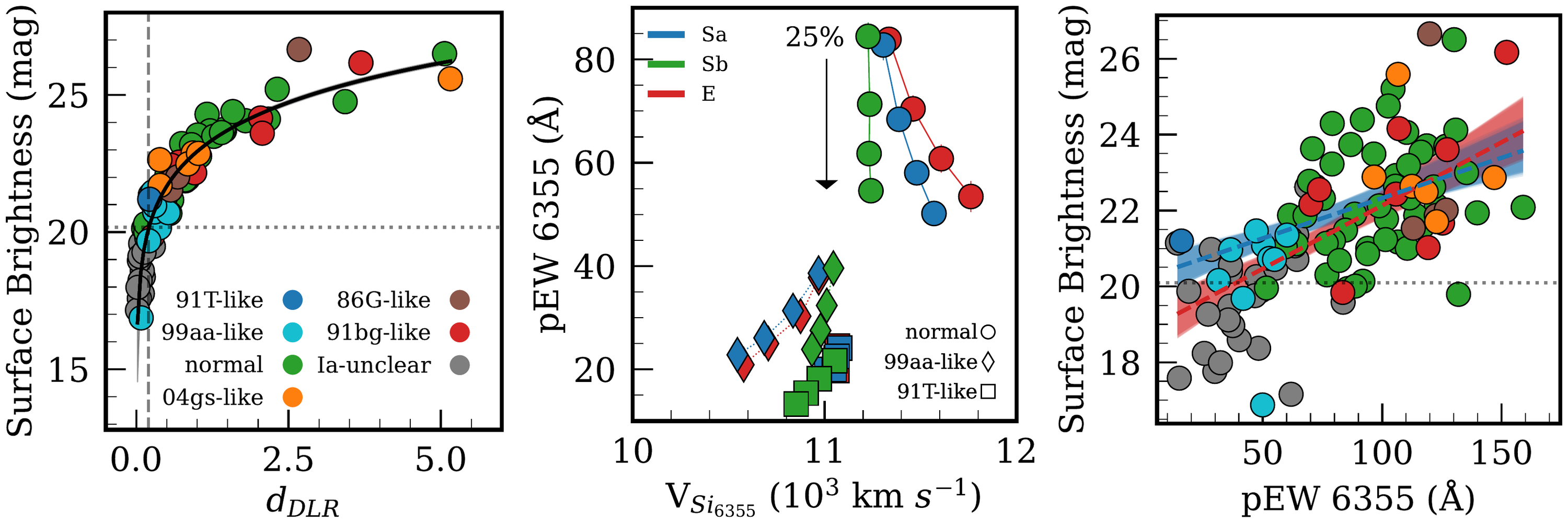
  • Host-galaxy light can reduce Si II λ6355 line strength by about 17–50%, while measured velocities shift by no more than roughly 500 km s−1.
  • A dDLR > 0.2 cut removes the most contaminated spectra and yields a cleaner 392-object classification sample.
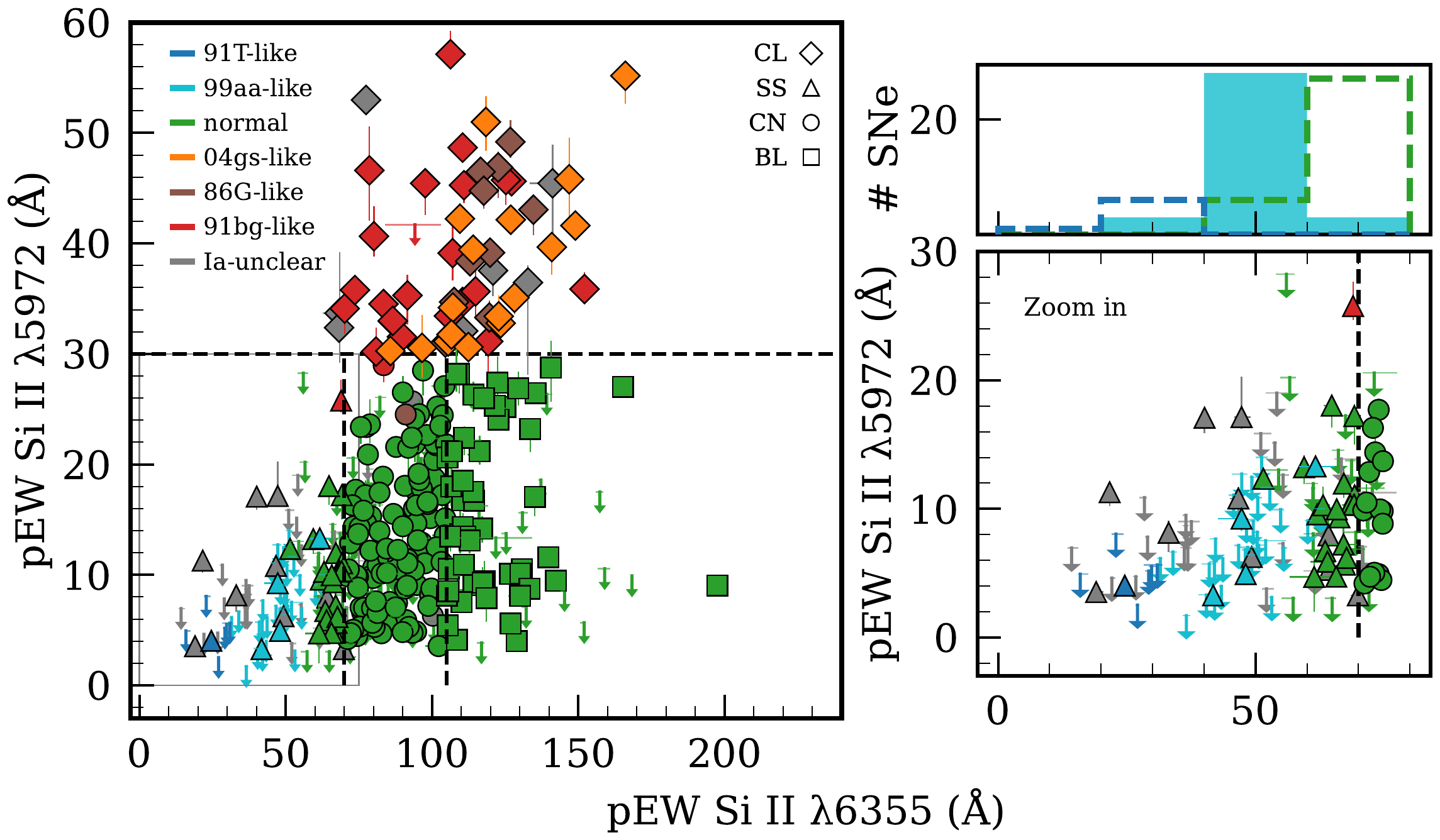
  • The Branch diagram maps a continuous sequence from 91T-like through 99aa-like and normal to cooler transitional events.
Three-panel plot showing host-galaxy contamination effects on Type Ia supernova spectral measurements
Figure 6. Host light changes Si II line strength—and therefore classification—more than velocity.
Branch diagram of Type Ia supernova subclasses using two silicon line strengths
Figure 7. Si II line strengths trace the transition between bright, normal, and cool spectral classes.
2. Host Galaxies and SN Ia Diversity How does host stellar mass shape light-curve width, spectroscopic subtype, and ejecta velocity? I map SN Ia populations across the lowest-mass galaxies in ZTF DR2.

Key findings

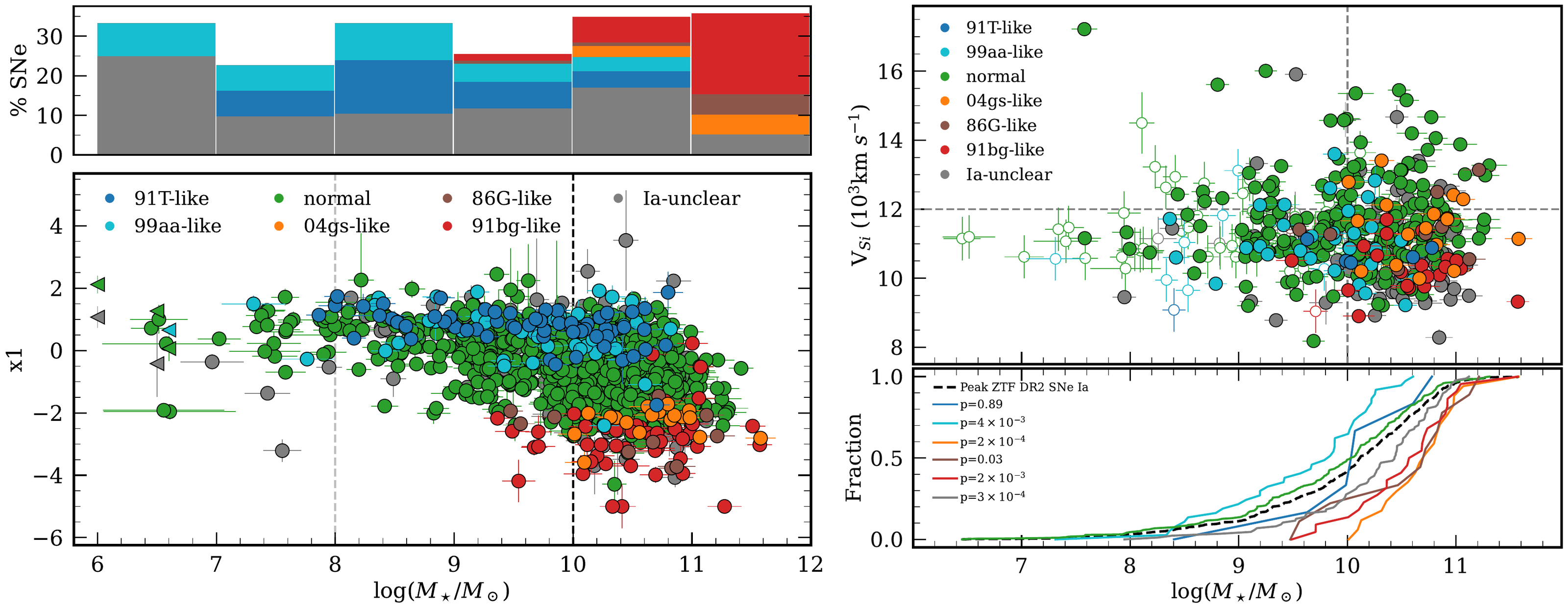
  • Normal SNe Ia dominate every host-mass bin, contributing about 65–77% of the sample.
  • Bright 91T-like and 99aa-like events favour low- and intermediate-mass hosts; cooler faint subtypes appear mainly in massive hosts.
  • High-velocity events occur in low-mass galaxies too, pointing to earlier sample selection—not a strict host-mass threshold.
Host stellar mass compared with supernova light-curve stretch and silicon velocity
Figures 4–5. Subtype diversity and high-velocity events extend into low-mass host galaxies.
3. Precision Cosmology and Supernova Rates How do host-dependent luminosity steps and galaxy demographics propagate into SN Ia standardisation? I test velocity-selected populations and supernova rates across host mass.

Key findings

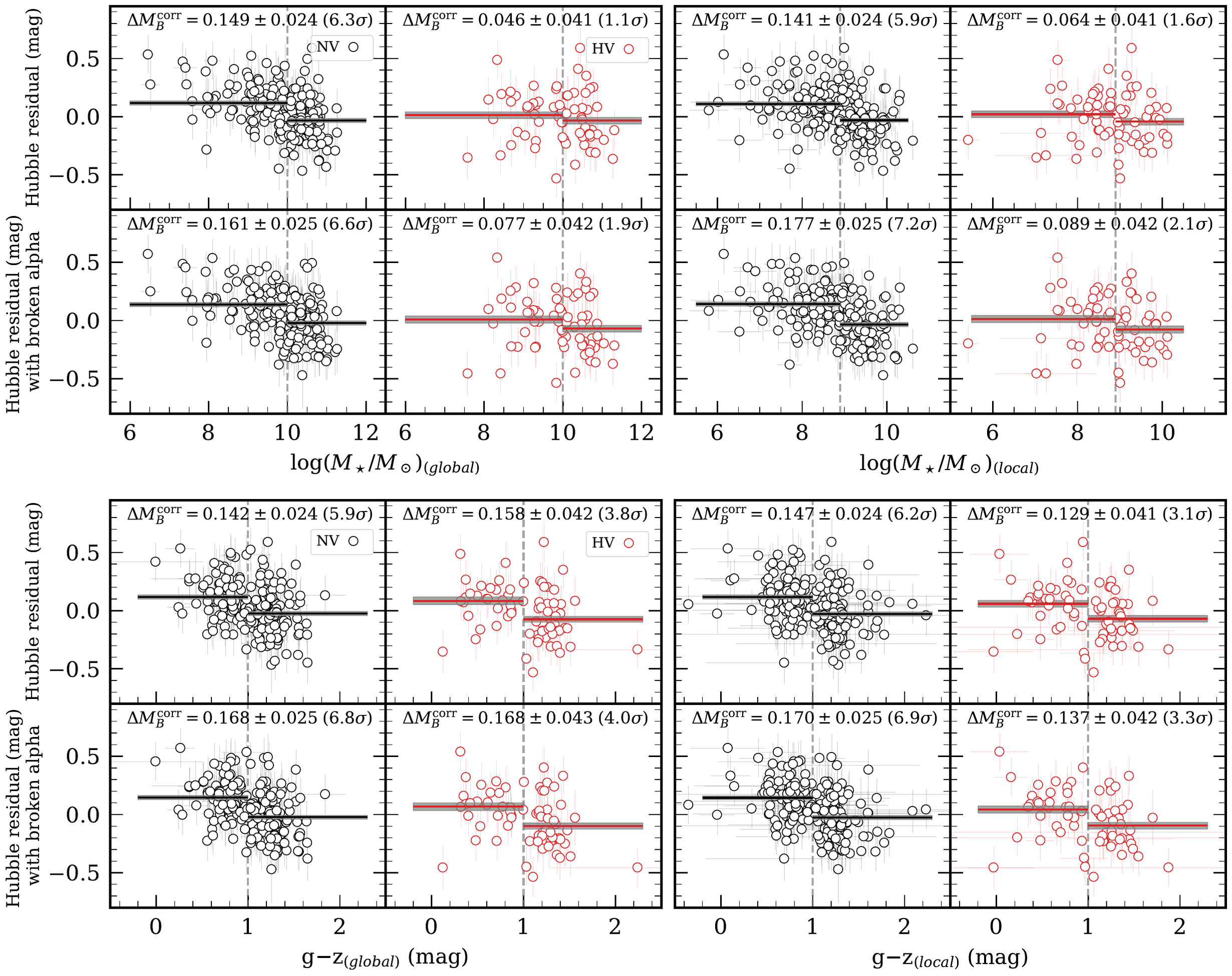
  • Normal-velocity SNe Ia show a strong global mass step: 0.149 ± 0.024 mag (6.3σ). The high-velocity step is 0.046 ± 0.041 mag (1.1σ), consistent with zero.
  • The strongest subtype contrast appears near galaxy centres, motivating subtype- and location-aware cosmological corrections.
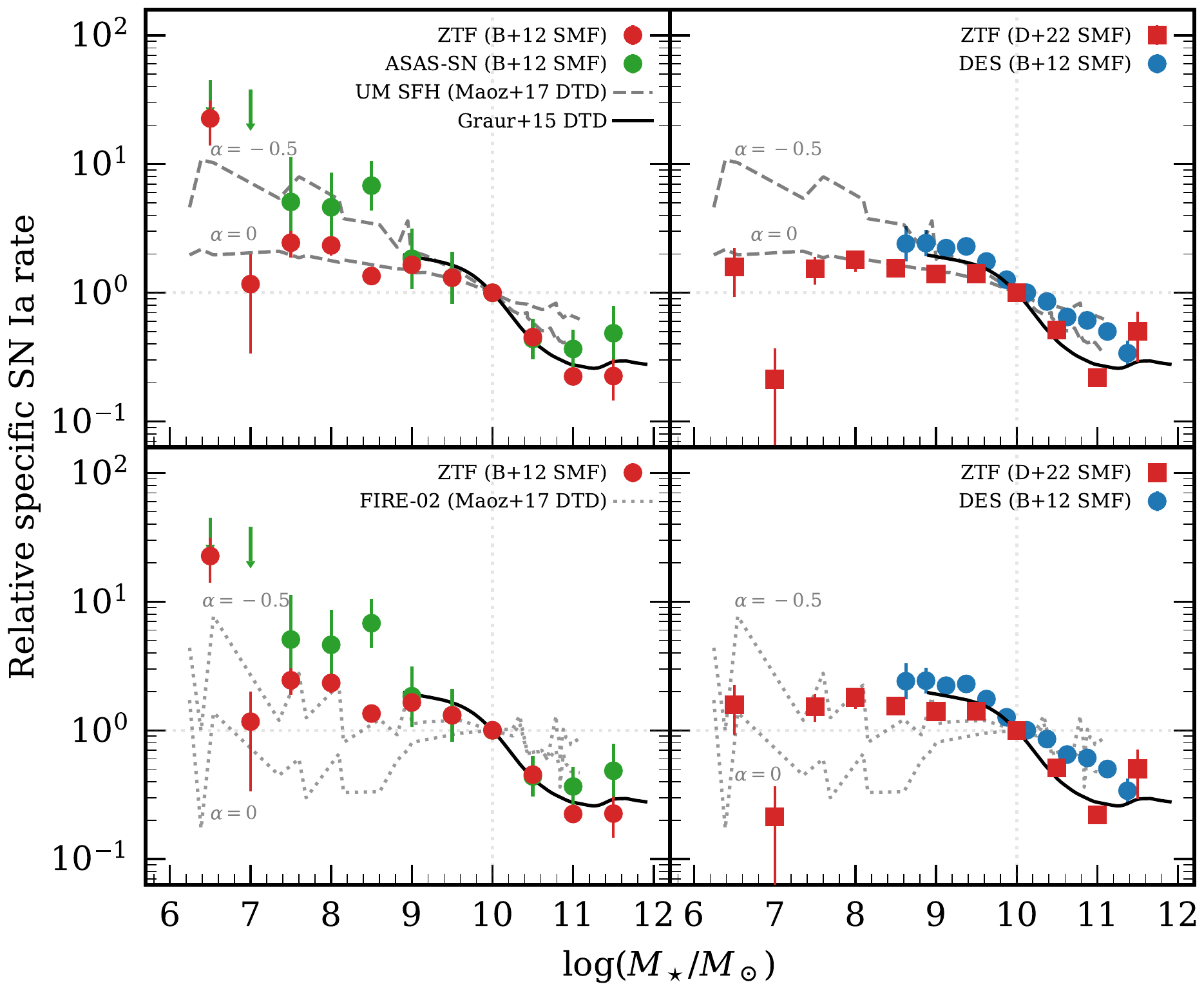
  • ZTF specific rates are comparatively flat in low-mass hosts and favour little or no metallicity dependence in delay-time models.
Hubble residual mass and colour steps separated into normal- and high-velocity supernova populations
Figure 3. Global and local mass and colour steps, separated into normal- and high-velocity populations.
Specific Type Ia supernova rate across host-galaxy stellar mass compared with surveys and models
Figure 8. SN Ia rate per unit stellar mass across galaxy mass, compared with surveys and delay-time models.
4. High-Velocity SNe Ia and Post-Maximum Light What does the post-maximum red-band excess of high-velocity SNe Ia reveal about their ejecta? SN 2017fgc provides a detailed benchmark.

Key findings

  • SN 2017fgc is a normal decliner but a high-velocity event: 15,200 ± 480 km s−1 near maximum light.
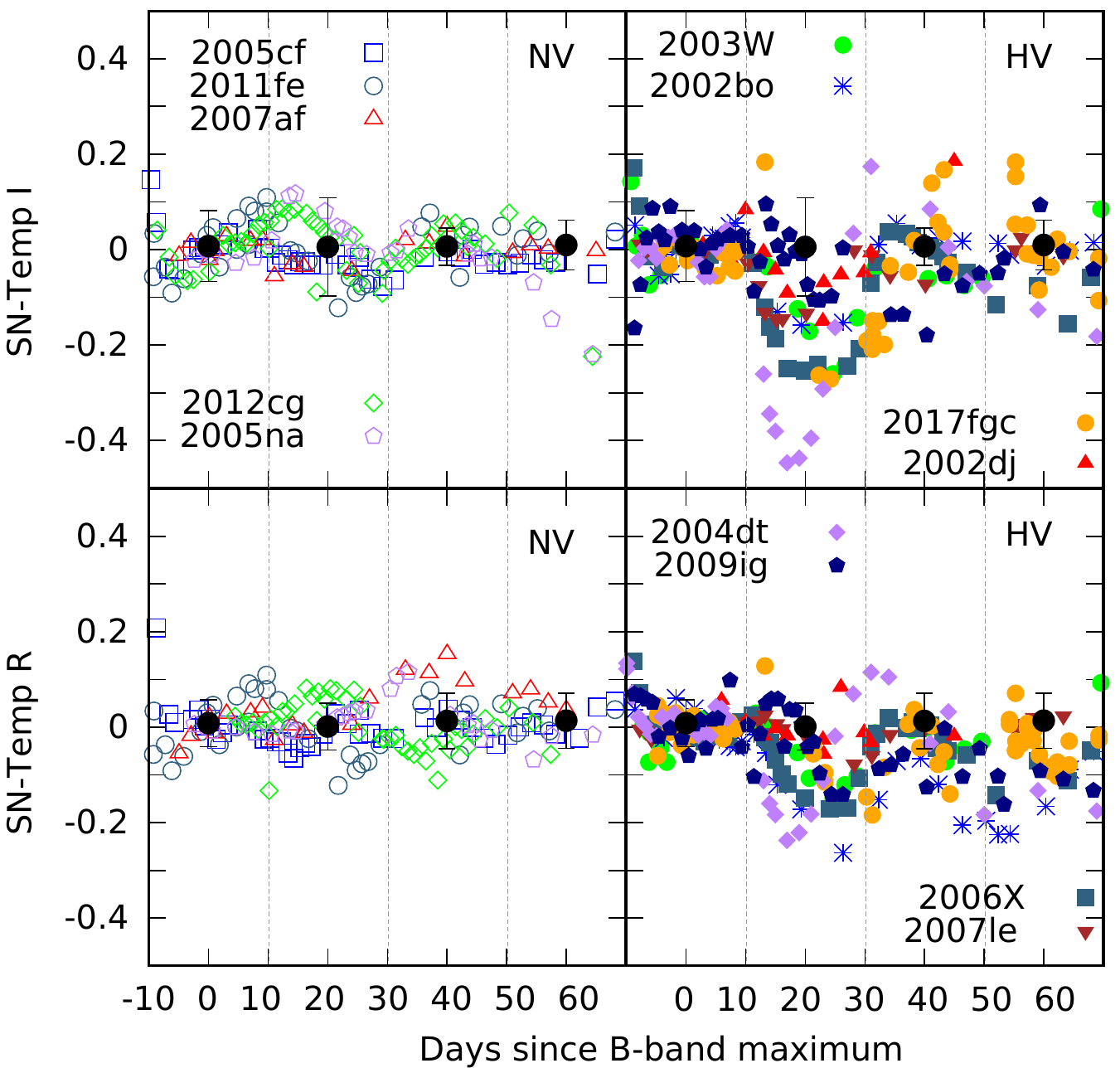
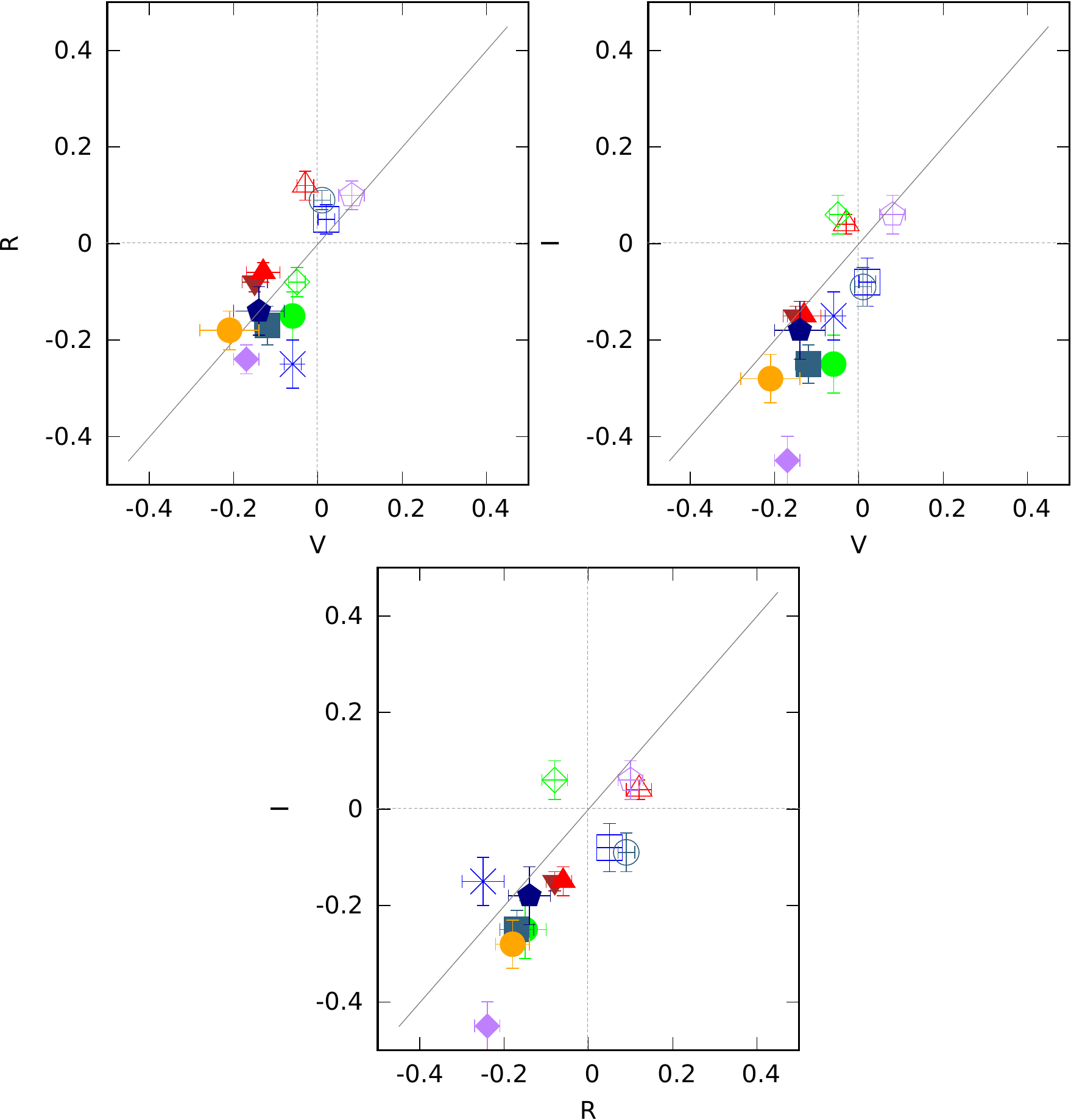
  • High-velocity SNe Ia show a clear R- and I-band excess around 20 days after maximum; normal-velocity events cluster around zero.
  • The excess grows toward redder bands and points to intrinsic ejecta or ionisation differences rather than dust echoes.
Template-subtracted R- and I-band light curves comparing normal- and high-velocity Type Ia supernovae
Figure 12. Template-subtracted light curves show the roughly 20-day excess and larger scatter of high-velocity events.
Cross-band light-curve excess comparison for normal- and high-velocity Type Ia supernovae
Figure 13. The excess is generally stronger toward redder wavelengths.

Selected Publications

  1. ZTF SN Ia DR2 follow-up: Exploring the origin of the Type Ia supernova host galaxy step through Si II velocities Burgaz, U., et al. 2026, Astronomy & Astrophysics https://doi.org/10.1051/0004-6361/202556376
  2. ZTF SN Ia DR2: Properties of the low-mass host galaxies of Type Ia supernovae in a volume-limited sample Burgaz, U., et al. 2025, Astronomy & Astrophysics https://doi.org/10.1051/0004-6361/202452571
  3. ZTF SN Ia DR2: The spectral diversity of Type Ia supernovae in a volume-limited sample Burgaz, U., et al. 2025, Astronomy & Astrophysics https://doi.org/10.1051/0004-6361/202450386
  4. Light-curve properties of SN 2017fgc and HV SNe Ia Burgaz, U., et al. 2023, Monthly Notices of the Royal Astronomical Society https://doi.org/10.1093/mnras/stab254

You can find all of my publications on NASA-ADS.

All publications

Curriculum Vitae

Academic CV

My three-page academic CV covers appointments, education, survey collaborations, grants, teaching and supervision, observing experience, technical skills, scientific service, talks, and selected publications.

3-page PDF · 472 KB